Tyler v. Hennepin: How a 94-Year-Old Woman Won Your Right to Claim Surplus Funds
Geraldine Tyler was 94 when her county sold her condominium for $40,000 over a $15,000 debt and kept every dollar. She took it to the Supreme Court of the United States and won, unanimously. Florida had protected that money for generations before the ruling. What Tyler did was settle the question for the whole country, and none of it happens on its own.
By Ana Larrubia, c/o Abraham and Associates Asset Recovery Services, LLC
Video · 7 min
Sections
- A County Sold Her Home and Kept Everything
- She Went First So You Don't Have To
- What the Fifth Amendment Actually Says
- Florida Was Already Ahead of It
- Nobody Mails You a Check
- Your Equity Doesn't Sit Still While It Waits
- How Abraham and Associates Brings It Home
- Find Out What Is in Your Name: Start With a Free Consultation
- Common Questions

NOTICE (EU AI Act, Art. 50): The visuals and voice in this video were generated with artificial intelligence. No footage of an actual person was recorded. By Ana Larrubia, c/o Abraham and Associates Asset Recovery Services. Reviewed for accuracy; sources are linked below.
A County Sold Her Home and Kept Everything
Geraldine Tyler was 94 years old when the Supreme Court of the United States ruled in her favor. Nine justices heard her case. Not one of them disagreed.
She wasn't a lawyer. She bought a one-bedroom condominium in Minneapolis in 1999 and lived there alone for more than ten years. As she got older, she and her family decided she'd be safer in a senior community, so in 2010 they moved her to one. After that, nobody paid the property taxes on the condo.
The original tax bill was around $2,300. With interest, penalties, and costs stacked on top, the county said the total came to roughly $15,000. So the county took her condominium and sold it for $40,000. Then it kept all $40,000.
Read that number one more time. Fifteen thousand of it settled what she owed. The other twenty-five thousand was her equity, built over years of ownership, and the county kept it because the law in Minnesota at the time let it.
If something in your chest just tightened, that's the correct response. That's the same thing Geraldine felt. The difference is what she did next.
She Went First So You Don't Have To
A 94-year-old woman sued her county government.
She lost in the district court. She lost again in the court of appeals. Most people stop there, and nobody would blame them. She kept going, all the way to the highest court in the country, and on May 25, 2023, the Supreme Court ruled unanimously in her favor.
That's the part worth sitting with. She was 94. She wasn't going to get those years back. She fought anyway, and the ruling she won now protects every former owner in America, including you.
Your fight is already over. Somebody else had it for you.
What the Fifth Amendment Actually Says
The rule is short. When the government takes something that belongs to you, it has to pay you for it. That's the Fifth Amendment to the Constitution. Lawyers call it the Takings Clause, and it's been sitting there since 1791.
Picture it this way. You owe your neighbor twenty dollars. To collect, they sell your bicycle for sixty. They can keep the twenty you owed them. They can keep what it actually cost them to sell it. The rest of that money is still yours. It never stopped being yours for a single second.
That's what the Court said Hennepin County got wrong. Chief Justice Roberts put it in a line worth remembering: “The taxpayer must render unto Caesar what is Caesar's, but no more.”
The government can collect the debt. It can collect its costs and its processing fees. Everything above that line is your money, and keeping it is now unconstitutional in all fifty states.
Florida Was Already Ahead of It
Here's the part that matters for Florida, and it's good news. Florida law recognized this long before Tyler ever reached the Supreme Court, and the state's tax deed surplus statute traces back to 1935. What the ruling changed was the rest of the country. When a Florida property sells at a foreclosure auction or a tax deed sale for more than what was owed against it, that difference belongs to the former owner. Florida calls it surplus funds. You might hear it called foreclosure surplus, surplus cash, or tax deed surplus depending on which kind of sale it came from. The names change. The ownership doesn't.
It's your equity. The auction converted your property into cash, and the cash above the debt is still yours.
Florida has to give it back to former owners who claim it. That last word carries all the weight.
Nobody Mails You a Check
This is the part that costs people their money, and it has nothing to do with whether they deserve it. Florida law gives you the right to that money, and Tyler made keeping it unconstitutional everywhere. Getting it back still takes a claim.
There's no button somebody presses. No system quietly scans for your name and mails you a check. It's a claims process, and it was never designed to run on its own. Your money sits exactly where it is until someone tells the government, in the form and the language it requires, that this money belongs to you, and then proves it.
You can do that yourself. That right is completely yours, and our team would never suggest otherwise.
What we'll tell you honestly is what the work looks like once you're inside it. You have to establish that you're the person the records point to. You have to account for any liens or competing claims sitting against that money. And you have to satisfy a county court that reads paperwork strictly and doesn't grade on effort. A claim filed wrong is a claim that fails, and your money keeps sitting where it is.
Your Equity Doesn't Sit Still While It Waits
Florida law lets money held after a sale be invested while it waits, and the return that investment earns isn't part of what comes back to you. Our team wrote about how that works in FLGIT and Your Equity.
FLGIT and Your Equity: Where Does the Interest Go While Florida Holds Your Surplus Funds?
So waiting carries a cost, and it isn't the government carrying it.
How Abraham and Associates Brings It Home
What we do is straightforward, and we call it The Abraham Recovery Method: we Verify, we File, and we Deliver. We verify whether money is waiting from your sale, whether the records point to you, and what liens or competing claims sit against it. We prepare and file the claim, working through a power of attorney paired with an attorney who is a member of The Florida Bar, so the paperwork lands the way a court expects it to land. Then we carry it through until the money reaches your hands.
Your claim stays your claim, in your name, start to finish. You pay from what we recover, and only from what we recover.
Geraldine Tyler was 94 years old. She took on a county government, carried it to the Supreme Court of the United States, and won a right that now belongs to you. You don't have to do any of that. That fight is finished. Yours is a phone call.
Find Out What Is in Your Name: Start With a Free Consultation
The first conversation is free. We'll explain how recovery works, what matters most in your situation, and the most direct path to bring your equity back into your hands.
Schedule your free consultation. There is no obligation and no upfront cost. Call or text (305) 307-1634, Monday through Friday, 8:30 AM to 5:30 PM, or (844) 454-2884 from outside Florida. A real person answers the phone. Hablamos Español.
Claim What's YoursCommon Questions
Do foreclosed properties sell at market value?
Does Tyler v. Hennepin mean the government sends me my money automatically?
My property sold a while ago. Is it worth asking now?
Does this apply to tax deed sales, or only mortgage foreclosures?
What does it cost to work with your team?
Disclaimer: Abraham and Associates is not a law firm, and we are not attorneys. The account of Tyler v. Hennepin County is drawn from the Supreme Court's published opinion and contemporaneous reporting. It is shared for general information and is not legal advice.
Keep reading
Video · 3 min
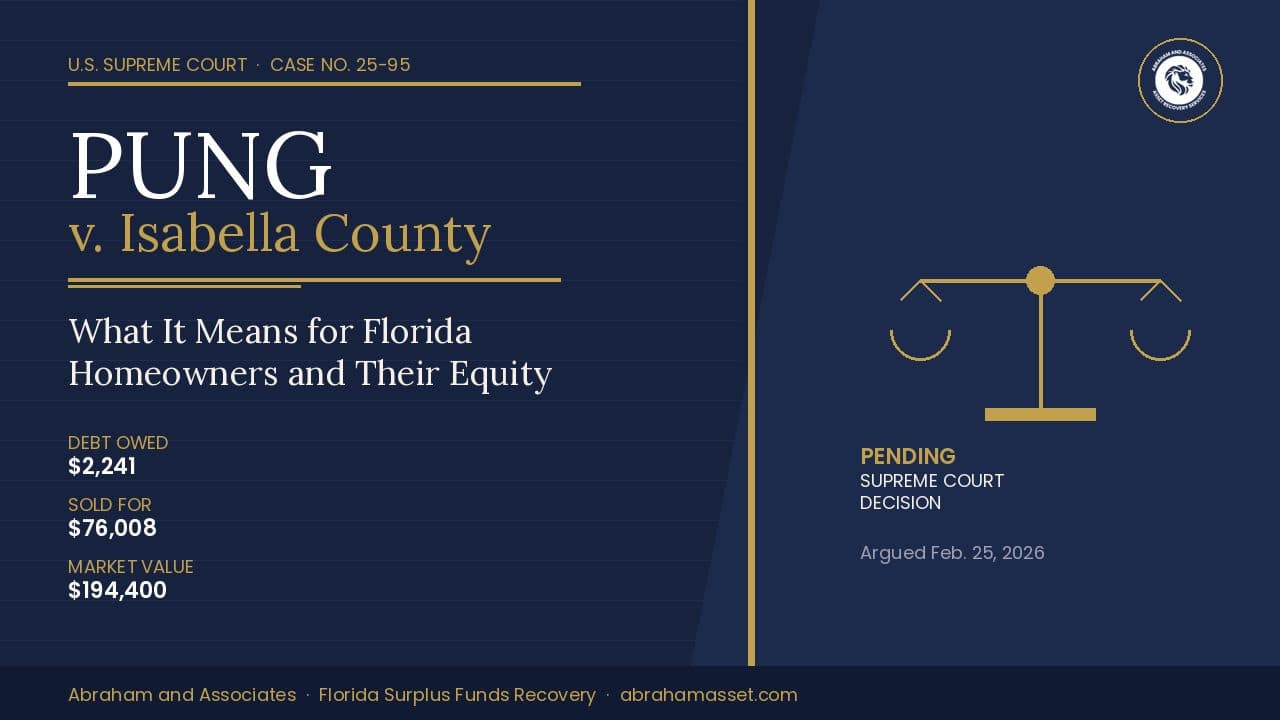
Pung v. Isabella County: What the Supreme Court's Home Equity Ruling Means for Florida
Watch and read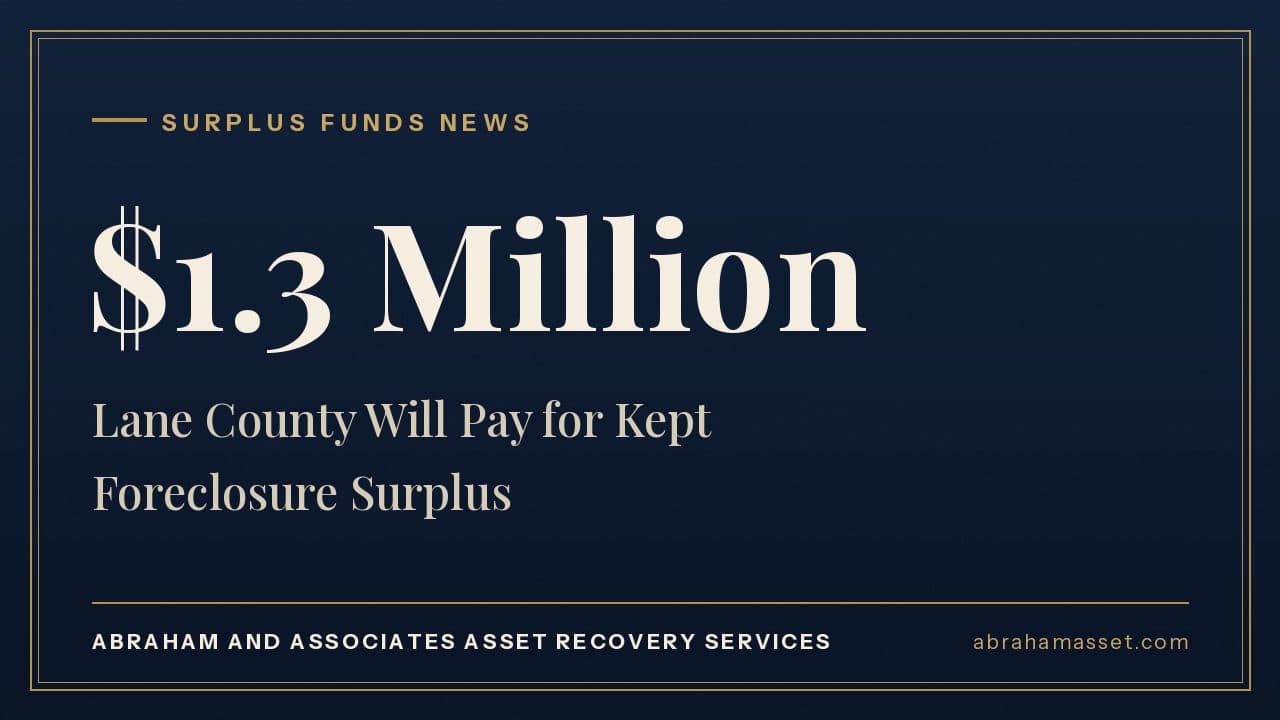
Video · 5 min
Lane County Will Pay $1.3 Million for Kept Foreclosure Surplus: More Proof Your Equity Belongs to You
Watch and read
Video · 8 min
FLGIT and Your Equity: Where Does the Interest Go While Florida Holds Your Surplus Funds?
Watch and read
For your situation: Tax Deed Surplus Recovery
Sources
- Tyler v. Hennepin County, 598 U.S. 631 (2023), slip opinion (decided May 25, 2023)Supreme Court of the United States
- Tyler v. Hennepin County, 598 U.S. 631 (2023)U.S. Supreme Court, via Justia
- Tyler v. Hennepin County, opinion text and syllabusCornell Legal Information Institute
- Justices rule Minnesota county violated Takings Clause by keeping surplusSCOTUSblog
- Supreme Court rules in favor of 94-year-old woman who got nothing when county took her condoKARE 11
This article is provided for general informational purposes and does not constitute legal advice. The information here reflects general principles under Florida law and may not apply to your specific situation. Florida foreclosure and surplus fund recovery law is complex and subject to change. Abraham and Associates Asset Recovery Services, LLC is not a law firm. We work in partnership with attorneys who are members of The Florida Bar to assist clients through the recovery process.
© 2026-2027 Ana Larrubia, c/o Abraham and Associates Asset Recovery Services, LLC. All rights reserved.